Cookie settings
We use cookies to run the website securely and activate optional features like analytics and marketing only with your consent. Learn more
All BARBARIC products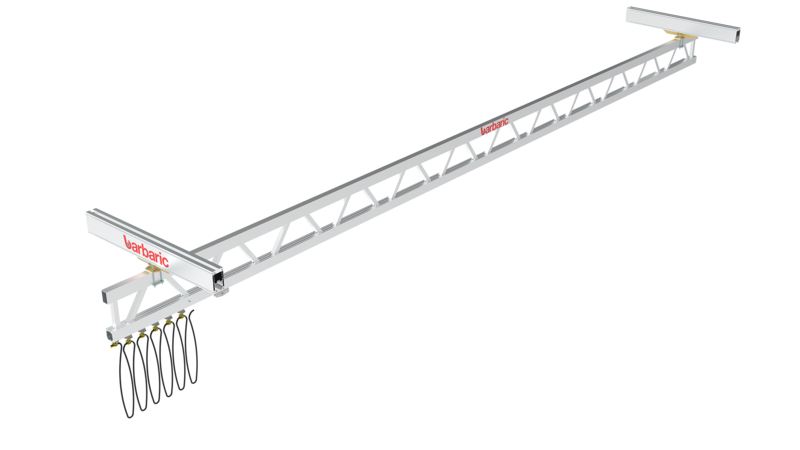
Crane & Rail Systems
2D Alu-Fachwerksbrücke Barbaric
Aluminium truss bridge in 2D design
BARBARIC 2D Alu-Fachwerksbrücke is a crane & rail systems as a carrier system for vacuum lifters in manual wood handling. Asamer delivers, installs and services BARBARIC systems in CZ, SK and HU.
The 2D aluminium truss bridge is a two-dimensional aluminium truss structure for modular crane systems. Lightweight, stable and flexibly usable for different spans.
Send inquiryHighlights
- Lightweight aluminium truss
- 2D planar design
- Flexible span lengths
- Modular crane integration
- Stable low-deflection structure
Specifications
4- Design
- Aluminium truss bridge 2D
- Span
- customer-specific
- Material
- Aluminium
- Use
- Modular crane systems
Software integration
BARBARIC systems like the 2D Alu-Fachwerksbrücke feature open interfaces to machine manufacturers. Our software team extends this to your ERP or production system.
Learn moreIn Detail
The Barbaric 2D truss bridge is a ceiling-mounted vacuum crane with two travel axes (X and Y) that covers a rectangular hall area completely. It consists of two parallel crane runways along the long sides of the hall and a truss bridge moving transversely across them, with the vacuum gripper mounted on it. This allows any point of the rectangular area to be approached directly — ideal for flat material flows, CNC loading, panel saw and chaotic storage zones. Unlike the SSY rail system, the 2D truss bridge is not restricted to linear movement but serves an entire hall floor area. Typical applications are medium and large furniture operations, joinery shops with several CNC workstations and industrial plants with panel storage. Asamer plans 2D truss bridges for production plants in Czech Republic, Slovakia and Hungary — including statics, hall coverage, ERP integration and safety acceptance.
Applications
For medium and large furniture operations
In a medium-sized furniture production, several CNCs, panel saws and panel storage areas often come together. The 2D truss bridge connects all stations flexibly — each station can be supplied from any panel stack position, independent of fixed transport routes.
For chaotic storage areas
When panels are stored chaotically for space reasons rather than sorted by fixed decors, the crane needs access to every stacking position. The 2D truss bridge is the basis for a fully automated flat-layout storage according to the CSF principle — or operates manually and semi-automatically for smaller operations.
Buying Guide
The 2D truss bridge is the standard choice when you need to cover an entire hall area. For pure linear movements, an SSY rail system suffices and costs less. If you additionally need multi-level movements (e.g. across rack levels), the 3D truss bridge is the right choice. Asamer advises which class suits your layout.
FAQ
Interested?
We work with you to plan the optimal solution for your production.