Cookie settings
We use cookies to run the website securely and activate optional features like analytics and marketing only with your consent. Learn more
All BARBARIC products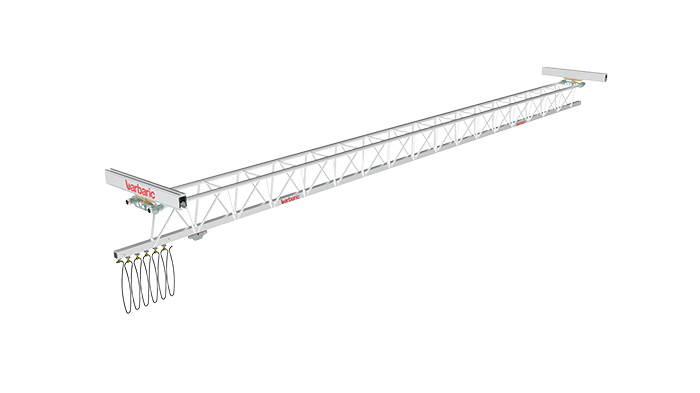
Crane & Rail Systems
3D Alu-Fachwerksbrücke Barbaric
Aluminium truss bridge in 3D design – higher load capacity
BARBARIC 3D Alu-Fachwerksbrücke is a crane & rail systems as a carrier system for vacuum lifters in manual wood handling. Asamer delivers, installs and services BARBARIC systems in CZ, SK and HU.
The 3D aluminium truss bridge offers significantly higher stiffness and load capacity than the 2D variant thanks to its three-dimensional structure. Ideal for demanding handling tasks with large spans.
Send inquiryHighlights
- 3D spatial truss geometry
- Higher stiffness vs 2D variant
- Larger practical spans
- Aluminium lightweight construction
- For demanding handling tasks
Specifications
5- Design
- Aluminium truss bridge 3D
- Span
- customer-specific
- Material
- Aluminium
- Advantage
- Higher stiffness and load capacity
- Use
- Demanding large-span applications
Software integration
BARBARIC systems like the 3D Alu-Fachwerksbrücke feature open interfaces to machine manufacturers. Our software team extends this to your ERP or production system.
Learn moreIn Detail
The Barbaric 3D truss bridge is the most capable vacuum crane variant — it extends the 2D bridge with a Z-axis, enabling multi-level movements between stacked storage levels or working heights. Typical applications are fully automatic multi-level flat-layout storage (CSF Multilevel), halls with multiple work plateaus or processes that must simultaneously serve the panel saw and a lower-positioned coating line infeed. The Z-axis offers several hundred millimetres up to several metres of stroke, depending on hall layout. The crane can be positioned more precisely than a 2D bridge but is mechanically more complex, accordingly higher in acquisition cost and requires more hall height. Asamer plans 3D truss bridges for industrial plants and multi-level panel storage in Czech Republic, Slovakia and Hungary — including structural dimensioning, software integration, ERP integration and commissioning.
Applications
For multi-level storage (CSF Multilevel)
A multi-level flat-layout storage per the CSF Multilevel principle requires the 3D truss bridge: panels must be moved from level 1 to level 2 or 3, sometimes within one motion. The Z-axis handles the vertical segment and hands over to the actual storage level.
For complex multi-process manufacturing
If your process has multiple working heights — for example a high-positioned panel saw and a lower-positioned CNC worktable or coating infeed — the 3D bridge safely bridges the height difference. This saves additional handover equipment or conveyors.
Buying Guide
Choose the 3D truss bridge only if you actually need multi-level movements — typical for CSF Multilevel or processes with significantly different working heights. For single-level area coverage, the 2D bridge costs around 30 % less and is sufficient in most applications. Before quoting, Asamer clarifies Z-axis requirements and hall geometry in detail.
FAQ
Interested?
We work with you to plan the optimal solution for your production.